

If you are searching for a capital gains tax calculator Australia investors can trust, it helps to understand what the calculator is actually doing. The maths is the same every time: work out your capital gain, apply any discount, and add the result to your taxable income for the year.
This guide walks through each step in plain English. When you are ready, you can run your own figures through our free property calculators. For the full rules on when CGT applies, see our capital gains tax on investment property guide.
The CGT Formula in One Line
The gain is not taxed separately. It is added to your other income and taxed at your marginal rate in the year the sale contract is signed.
How to Calculate Capital Gains Tax on a Property: 5 Steps
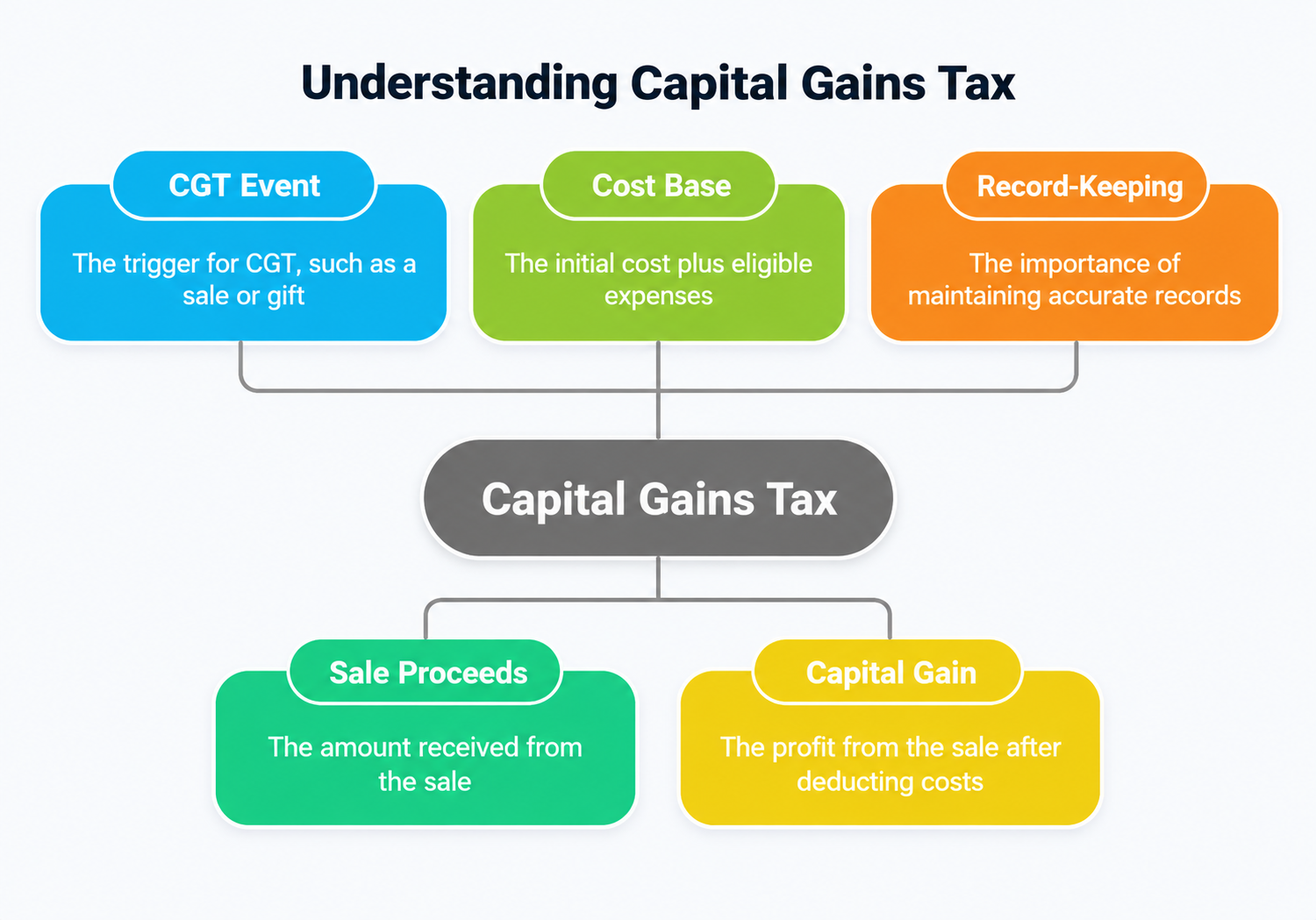
- Find your sale price (capital proceeds). Use the price in the contract of sale. The CGT date is the contract date, not settlement.
- Add up your cost base. This is what the property cost you to buy, hold and improve (see the list below).
- Subtract to get the gross gain. Sale price minus cost base. If the answer is negative, you have a capital loss.
- Apply capital losses, then the discount. Net off any capital losses first. Then, if you owned the property for more than 12 months, reduce the remaining gain by 50%.
- Add the result to your income. The taxable gain is taxed at your marginal rate for that financial year, plus the Medicare levy.
What Goes Into the Cost Base?
| Cost base element | Examples |
|---|---|
| Purchase price | The price you paid for the property |
| Buying and selling costs | Stamp duty, legal and conveyancing fees, agent commission, advertising |
| Capital improvements | Renovations, extensions, new kitchen (not repairs) |
| Ownership costs | Only costs you could not claim as a tax deduction |
| Title costs | Legal costs to defend or preserve your ownership |
Worked Example: CGT on an Investment Property
Here is a simple example for an investor who owned a Melbourne property for 6 years.
| Item | Amount |
|---|---|
| Sale price | $850,000 |
| Less: purchase price | − $560,000 |
| Less: stamp duty and legal costs | − $35,000 |
| Less: capital improvements | − $15,000 |
| Gross capital gain | $240,000 |
| Less: 50% CGT discount (held over 12 months) | − $120,000 |
| Taxable capital gain added to your income | $120,000 |
Illustrative only. The tax payable depends on your other income that year and your marginal rate. Speak to a registered tax agent about your situation.
Who Gets the 50% Discount?
- Individuals and trusts: 50% discount if held for more than 12 months.
- Super funds: 33.33% discount.
- Companies: no CGT discount.
- Foreign residents: generally no discount on gains made after 8 May 2012.
Common CGT Calculation Mistakes
- Forgetting stamp duty and legal fees in the cost base.
- Counting repairs as improvements. Only capital improvements add to the cost base.
- Using the settlement date instead of the contract date.
- Applying the 50% discount before netting off capital losses.
- Ignoring the main residence or six-year rule exemptions that could reduce or remove the gain.
Planning the Sale? Check Your Finance First
Your CGT bill is only one part of a sale. If you are selling to buy again, you also need to know your borrowing power, equity and loan structure. Negative gearing also affects how much tax you save while you hold the property, so read our guide to how to calculate negative gearing as well.
Selling or Buying an Investment Property?
Talk to a Melbourne mortgage broker about your next move before you sign the contract.
Try Our Free Calculators Book a Free ChatCGT Calculator FAQs
How do I calculate capital gains tax on a property in Australia?
What is the CGT date for a property sale?
Is stamp duty included in the cost base?
Can I offset a capital loss against other income?
Does the 50% discount apply to everyone?
This article is general information only and is not tax or financial advice. Speak to a registered tax agent or accountant about your situation.