

Who Benefits Most from Negative Gearing in Australia?
How negative gearing works, who receives the biggest tax benefits, and what the latest Australian data shows.
Higher-income property investors tend to receive a larger share of the benefit from negative gearing.
Negative gearing is one of Australia's most discussed property investment strategies. It can allow property investors to claim eligible rental property losses against other taxable income, potentially reducing the amount of tax they pay.
But an important question remains: who benefits most from negative gearing? The answer is not necessarily every property investor equally.
Research has consistently indicated that the benefits of negative gearing are concentrated among higher-income property investors. More recent Australian data also shows that higher-income earners receive a disproportionately large share of tax concessions associated with negative gearing and capital gains.
For property investors, negative gearing should be viewed as a tax outcome of an investment loss — not as a reason to buy an investment property by itself.
What Is Negative Gearing?
Negative gearing occurs when the deductible expenses associated with an investment property are greater than the rental income it generates.
Example
Rental income: $30,000 | Deductible expenses: $40,000 | Rental loss: $10,000
Depending on the investor's circumstances and Australian tax rules, that loss may be deductible against other taxable income. You can learn more in our detailed guide to negative gearing in Australia.
However, a tax deduction does not mean the investor receives the entire loss back as a tax refund. The investor still has an underlying investment loss.
Who Benefits Most from Negative Gearing?
The short answer: Higher-income property investors tend to receive a larger share of the benefit from negative gearing.
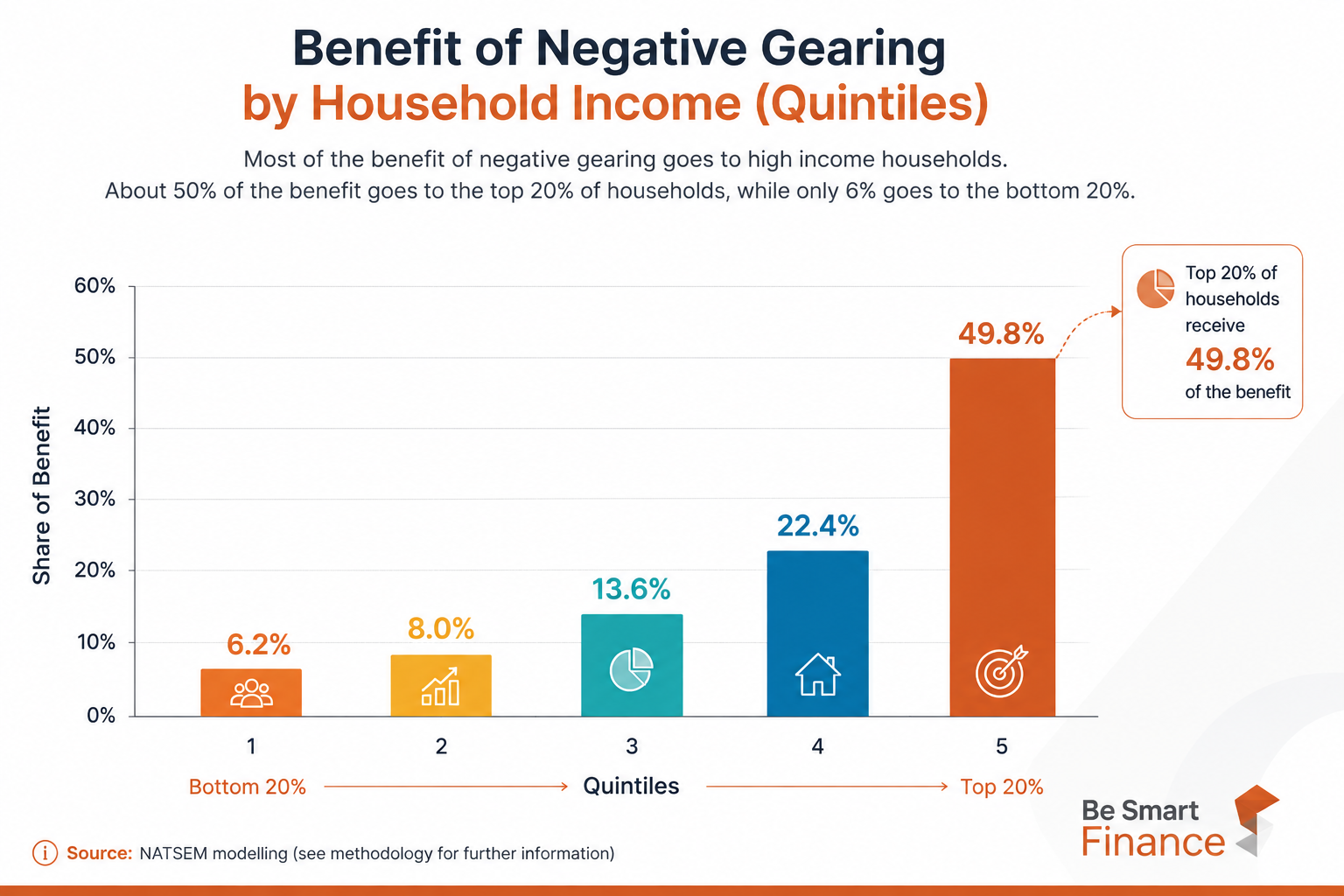
Benefit of Negative Gearing by Household Income (Quintiles). Source: NATSEM modelling, The Australia Institute (2018).
The Australia Institute's 2018 report, based on NATSEM modelling, found that approximately 49.8% of the benefit of negative gearing went to households in the top 20% by income, compared with approximately 6.2% for households in the bottom 20%.
Benefit of Negative Gearing by Household Income
| Household income group | Share of benefit |
|---|---|
| Bottom 20% | 6.2% |
| Second 20% | 8.0% |
| Middle 20% | 13.6% |
| Fourth 20% | 22.4% |
| Top 20% | 49.8% |
Source: The Australia Institute, November 2018 (NATSEM modelling). Historical data — not a current 2026 estimate.
These figures come from the 2018 Australia Institute report and should be treated as historical research, rather than current 2026 statistics.
Why Do Higher-Income Investors Often Benefit More?
One major reason is the way tax deductions interact with taxable income. If two investors have the same deductible rental loss, the potential tax impact can differ depending on their individual taxable income and circumstances.
Investor A vs Investor B
| Investor | Taxable income | Deductible rental loss |
|---|---|---|
| Investor A | $50,000 | $10,000 |
| Investor B | $150,000 | $10,000 |
The two investors may have the same property loss, but the tax outcome can differ because their taxable income and applicable tax rates are different — one reason negative gearing tends to be more valuable to investors with higher taxable incomes.
The tax deduction is only one part of the investment equation. An investor also needs to consider:
- Property purchase price
- Rental income
- Interest costs
- Maintenance and other expenses
- Vacancy periods
- Property growth potential
- Loan structure
- Cash flow
- Capital gains tax
- Selling costs
Does Negative Gearing Mean You Make Money?
Not necessarily. This is one of the biggest misconceptions about negative gearing. A negatively geared property is, by definition, generating a rental loss after relevant expenses.
Example
Rental income: $35,000 | Eligible expenses: $45,000 | Rental loss: $10,000
If that loss produces a tax saving, the investor's after-tax position may improve — but the tax saving does not automatically turn the property into a profitable investment.
What Does the Latest Data Show?
The discussion around who benefits most from negative gearing has continued into 2026. A May 2026 analysis by The Guardian, using Australian government budget data, reported that in 2022–23 the top 10% of income earners received 37% of the benefit of negative gearing. It also reported that the vast majority of the benefits of negative gearing and the capital gains tax concession went to people earning above the median income.
Read The Guardian's 2026 analysis on negative gearing and CGT →
2018 vs 2022–23: Two Different Snapshots
| Data point | Source | Finding |
|---|---|---|
| Top 20% households (income quintile) | Australia Institute, 2018 | 49.8% of benefit |
| Top 10% income earners | The Guardian, 2026 (2022–23 data) | 37% of benefit |
These figures should not be directly compared as though they measure exactly the same thing — different groupings, different years.
Together, they illustrate a broader pattern: negative gearing benefits are not evenly distributed across income groups.
Do Older Property Investors Benefit More?
The original Australia Institute research also examined the distribution of negative gearing benefits by age.
| Age group | Share of benefit |
|---|---|
| Over 40 | 71% |
| 40 and under | 29% |
Source: The Australia Institute, 2018. Historical figures, not a current estimate for 2026.
It found that approximately 71% of the benefit went to people aged over 40, compared with around 29% for people aged 40 and under.
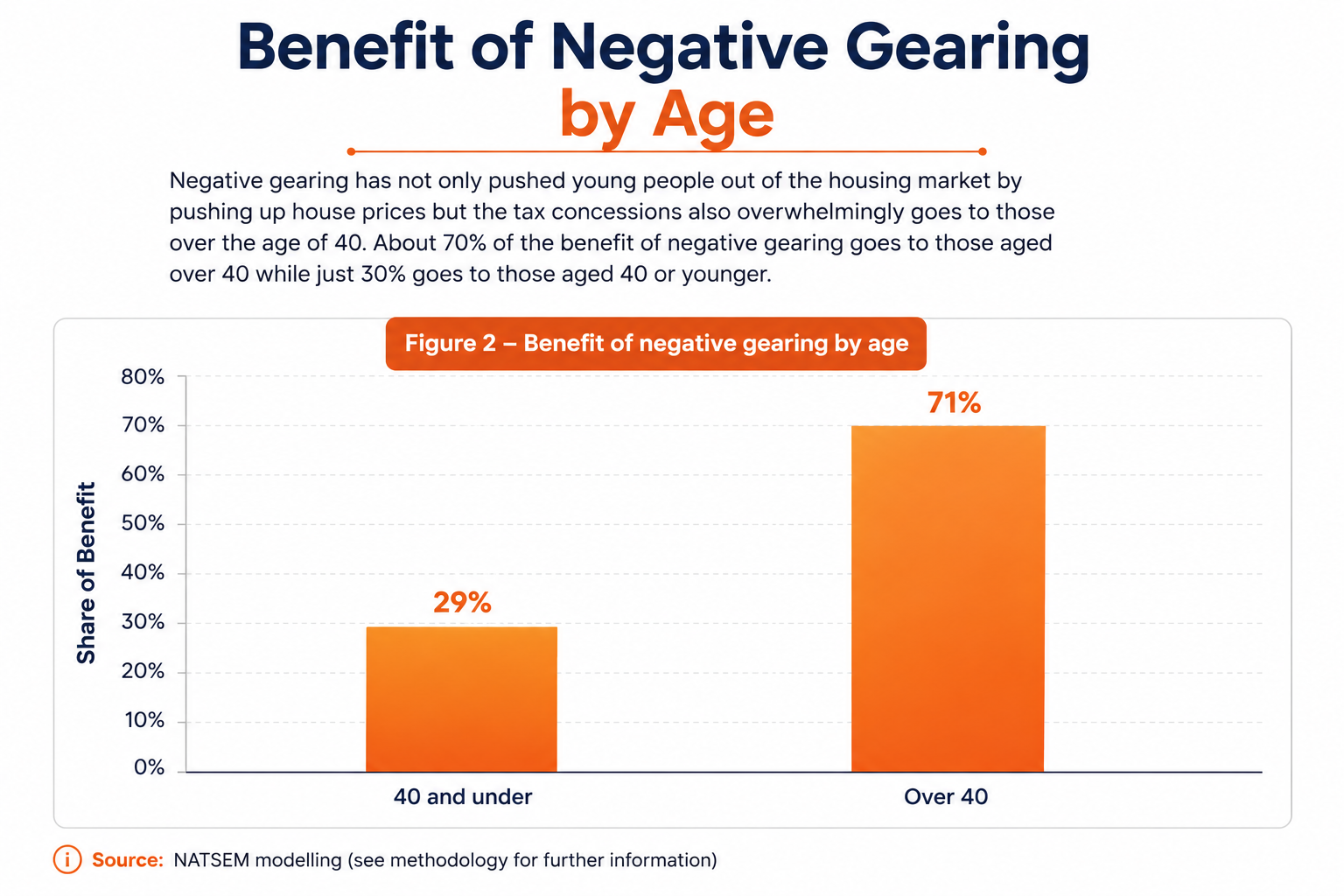
Historical distribution of negative gearing benefits by age. Source: NATSEM modelling, The Australia Institute (2018).
One possible reason is that older investors may have had more time to accumulate property assets and may have higher taxable incomes or larger investment portfolios.
Liberal Held Electorates and Negative Gearing
The original Australia Institute report examined the size of negative gearing deductions across electorates. It found that 8 of the top 10 electorates in its 2014–15 data were Liberal-held, with Wentworth ranking first.
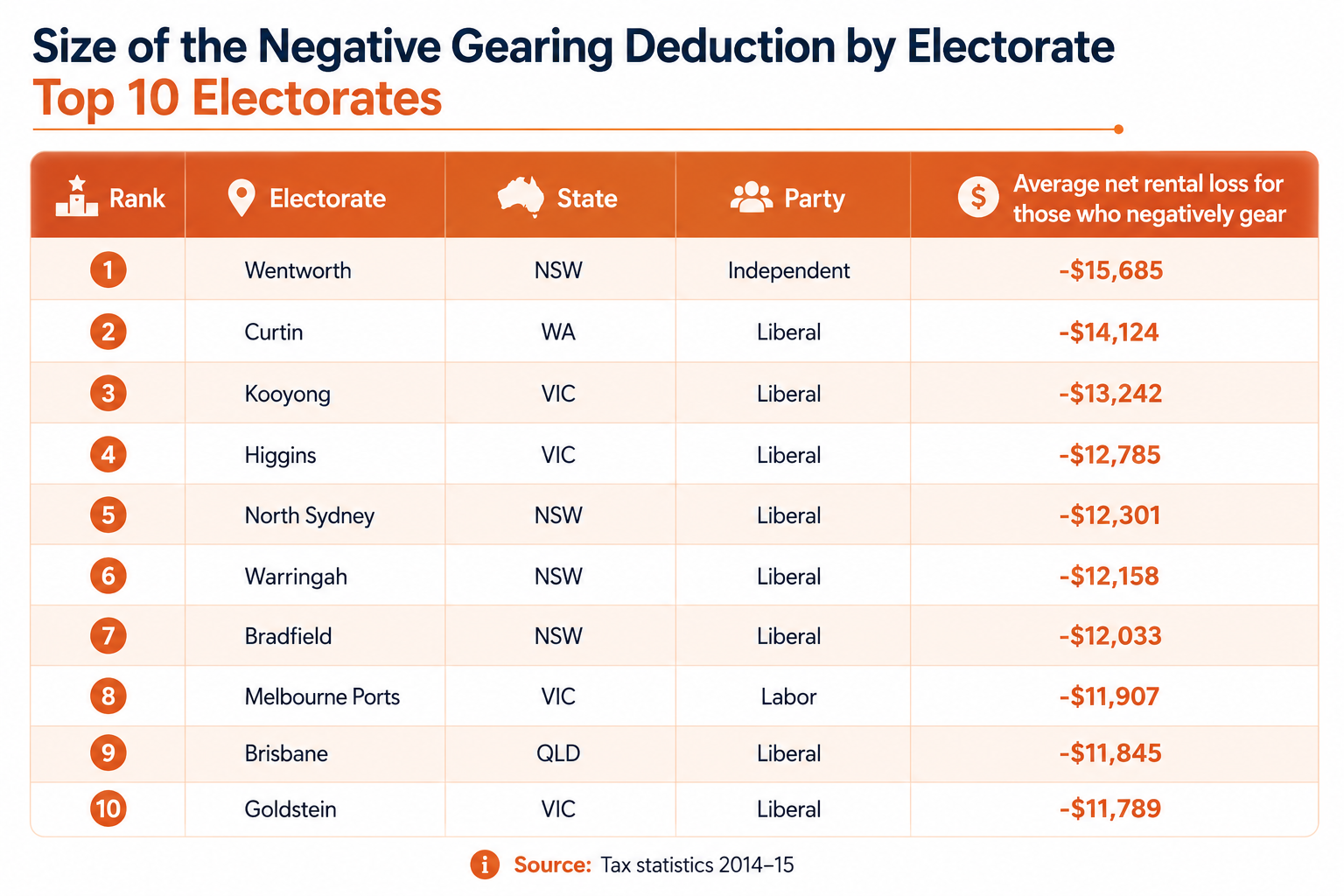
Average net rental loss for negatively geared taxpayers in the top 10 electorates. Source: Tax statistics 2014–15.
Is Negative Gearing Good for Every Property Investor?
No. Negative gearing can be useful in some investment strategies, but it is not automatically suitable for every investor. Before purchasing a negatively geared property, investors should consider whether they can comfortably manage the ongoing cash-flow shortfall.
A tax deduction may reduce the after-tax cost, but you still need sufficient cash flow to meet your loan and property expenses — particularly when:
- Interest rates increase
- Rental income falls
- The property remains vacant
- Unexpected repairs occur
- Property prices decline
- Your personal income changes
Negative Gearing vs Positive Gearing
Negative Gearing
Rental income < deductible expenses. The property generates a rental loss.
Positive Gearing
Rental income > deductible expenses. The property generates positive rental income before other tax factors.
Neither strategy is automatically better. A positively geared property may generate stronger ongoing cash flow, while a negatively geared property may be considered by some investors where the strategy relies partly on long-term capital growth. The right approach depends on the investor's financial position, goals, risk tolerance and investment strategy.
What About Capital Gains?
Negative gearing is often discussed alongside capital gains because investors may accept an ongoing rental loss in anticipation of potential long-term capital growth. However, capital growth is not guaranteed.
If an investment property increases in value, the investor may eventually realise a capital gain when selling, and capital gains tax can then become relevant. This means investors should look at the complete picture: rental income + tax impact + property expenses + loan costs + potential capital growth + CGT — rather than looking at negative gearing in isolation.
A Simple Example: Sarah's Investment Property
| Item | Annual amount |
|---|---|
| Rental income | $32,000 |
| Eligible deductible expenses | $42,000 |
| Rental loss | $10,000 |
If Sarah is eligible to claim the loss against other taxable income, the deduction may reduce her taxable income — but she has still incurred the underlying $10,000 loss. If the property subsequently increases in value, the potential capital growth may form part of her overall investment return. This is why a property should not be purchased simply because it is negatively geared.
Should You Invest in a Negatively Geared Property?
That depends on your individual circumstances. Before making a decision, consider:
1. Your Borrowing Capacity
Can you comfortably service the investment loan alongside your existing commitments?
2. Your Cash Flow
How much will you need to contribute each month after rental income and expenses?
3. Your Taxable Income
The potential tax impact of a deductible rental loss depends on your individual tax circumstances.
4. Property Fundamentals
Look at location, rental demand, vacancy rates, property type and long-term prospects.
5. Interest Rates
A change in interest rates can significantly affect the cost of holding an investment property.
6. Your Long-Term Strategy
Are you primarily looking for rental income, capital growth, diversification, or a combination?
Before considering an investment property, it's useful to understand what you may be able to borrow and how repayments could fit into your budget. Try the Be Smart Finance mortgage calculator. Results are estimates and do not represent a formal loan approval.
📄 Get the Full Report
Download our free research summary on negative gearing — household income, age and location data, all in one PDF.
So, Who Benefits Most from Negative Gearing?
The evidence suggests that higher-income property investors receive a disproportionately large share of the benefits from negative gearing. The Australia Institute's historical 2018 research found that almost half of the benefit went to households in the top 20% by income. More recent data reported in 2026, based on 2022–23 government figures, shows that the top 10% of income earners received 37% of the negative gearing benefit.
But this does not mean negative gearing is automatically a good or bad strategy. For an individual investor, the more important question is:
Does the investment make sense after considering the property's cash flow, financing costs, tax position, risks and long-term investment objectives?
Negative gearing should be one part of the investment strategy — not the strategy itself.
Frequently Asked Questions
Who benefits most from negative gearing?
Higher-income property investors generally receive a larger share of negative gearing benefits because deductible investment losses can have a greater tax impact depending on their taxable income and circumstances.
Is negative gearing available to everyone?
Negative gearing is not a separate government payment or grant. It relates to the tax treatment of eligible investment property losses. Whether a particular expense is deductible depends on Australian tax rules and the investor's circumstances.
Does negative gearing guarantee a tax refund?
No. A deductible loss may reduce taxable income and therefore potentially reduce tax payable, but the amount of any tax benefit depends on the individual's circumstances.
Is negative gearing the same as making a profit?
No. Negative gearing generally means the property is making a rental loss after relevant deductible expenses.
Is negative gearing still relevant in 2026?
Yes, negative gearing remains an important part of Australia's property and tax discussion. However, investors should consider current tax rules and obtain professional tax advice before making decisions.
Should I buy a property just for the tax deduction?
Generally, the tax deduction should not be the sole reason for purchasing an investment property. The property's price, rental income, expenses, financing, potential growth and your overall financial position should also be considered.
How Be Smart Finance Can Help
Negative gearing can be a useful part of an investment strategy, but choosing the right loan and understanding your borrowing position are equally important.
At Be Smart Finance, we can help you:
- Assess your borrowing capacity
- Compare suitable home and investment loan options
- Understand different loan structures
- Review your potential repayments and cash flow
- Explore finance options for your investment property goals
Every investor's financial circumstances are different, so getting the right guidance before committing to a property can help you make a more informed decision.
Ready to Explore Your Investment Property Finance Options?
Speak with Be Smart Finance today and take the next step towards your property investment goals.
👉 Contact Be Smart Finance